
EmbeddedAD: Efficient Anomaly Detection on SoCs via Vector-Quantized Reverse Distillation
Published in IEEE 39th International System-on-Chip Conference (SOCC), 2026
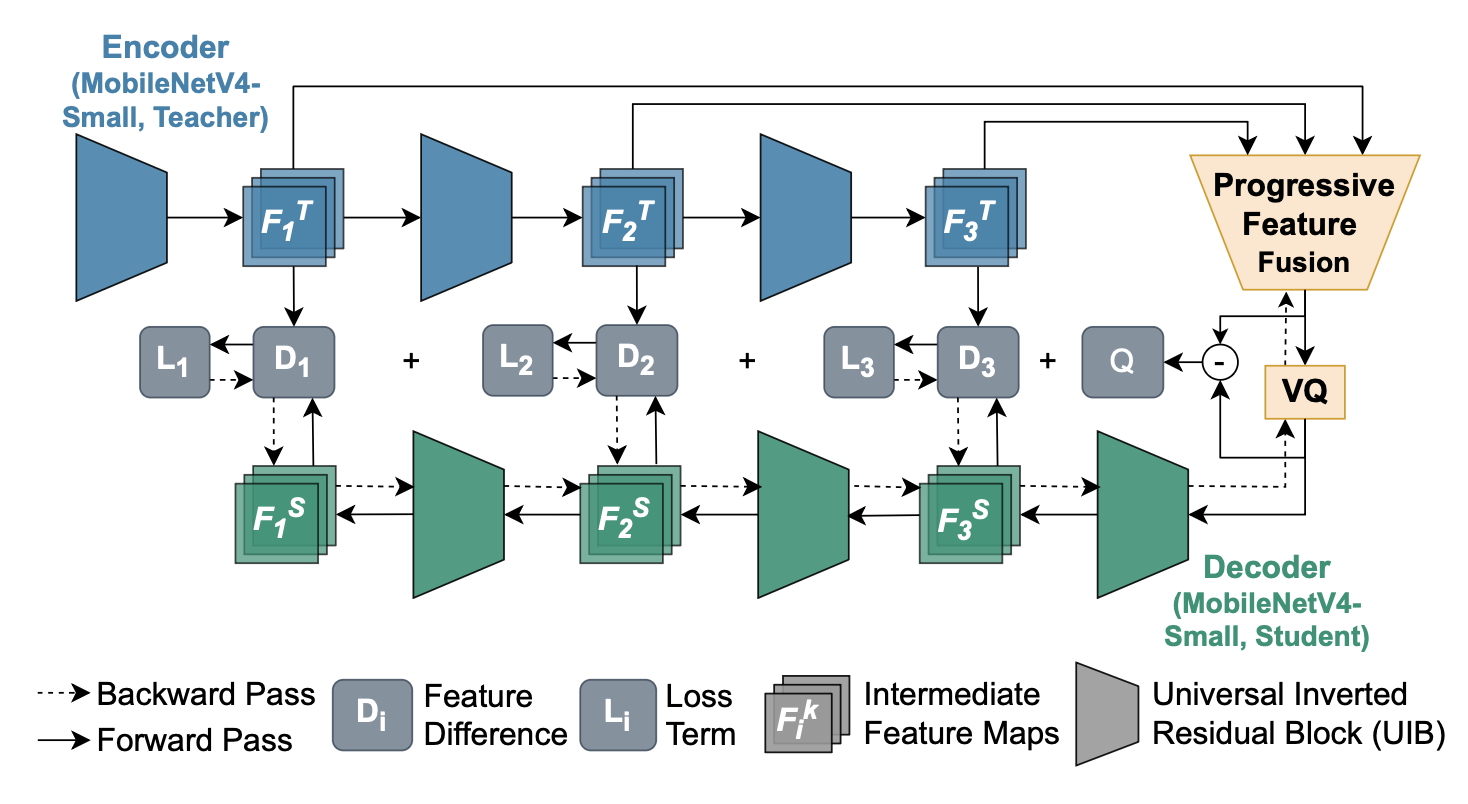
Unsupervised anomaly detection (AD) is a well established approach in applications where a sufficient number of training samples exists only for the normal class, but not for the anomalous class. However, existing AD methods are complex and therefore slow to compute on embedded system-on-chip (SoC). Based on a thorough analysis of state-of-the-art AD models, we identified reverse distillation as the most promising approach for execution on SoCs. Still, the approach suffers from computational redundancies and overparameterization. To overcome these shortcomings and enable fast and efficient execution of AD on the edge, we propose EmbeddedAD, a novel deep neural network (DNN) architecture class for unsupervised AD based on vector quantized reverse distillation (VQ-RD). EmbeddedAD introduces a new bottleneck alleviator that makes the model both robust and efficient. To further simplify the practical implementation of EmbeddedAD, we propose “double distillation”, a novel training method for reverse distillation AD models that removes the reliance on large DNN models pre-trained on ImageNet and instead allows the use of lighter architectures. Compared to the original reverse distillation approach, for EmbeddedAD we observe a 97 % reduction in memory requirements and a 7.7 times faster inference latency on a Raspberry Pi 5 SoC with almost the same AD precision.
Recommended citation: Deutel, M., Marchl, A., Plinge, A., Hannig, F., Teich, J., (2026). EmbeddedAD: Efficient Anomaly Detection on SoCs via Vector-Quantized Reverse Distillation. In: IEEE 39th International System-on-Chip Conference (SOCC).
Download Paper | Download Slides