
Early-Exit Neural Architecture Search for Energy-Harvesting Edge Computing
Published in IEEE 18th International Symposium on Embedded Multicore/Many-core Systems-on-Chip (MCSoC), 2025 (Best Paper Award)
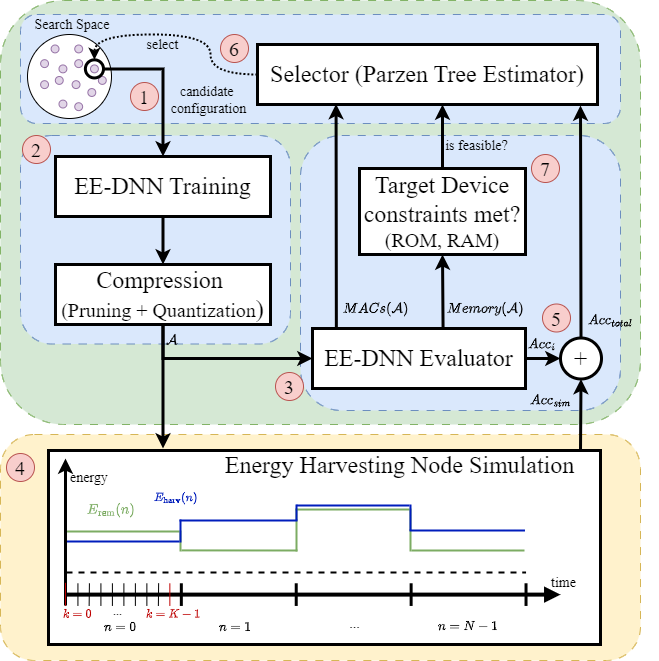
Energy harvesting (EH) is increasingly used in wireless sensor nodes to extend the lifetime of battery-powered devices in remote locations. On such devices, the use of deep neural networks (DNNs) is limited not only by the memory and computational constraints of the system, but also by the often large amount of energy required to perform DNN inference. As a result, continuous DNN inference cannot be guaranteed on such systems, especially under severe power constraints resulting from small battery capacities and solar panel sizes. A promising approach to dynamically adjust the power consumption of DNN inference are early-exit neural networks (EE-NNs), that allow a DNN to exit early at different points during its inference. In this paper, we propose a simulation-aided neural architecture search framework to explore EE-DNN architectures (EENAS) and an online energy manager (EM) that dynamically decides which early exit to take based on the available energy and the EE-NN’s confidence in its predictions while ensuring energyneutral operation (ENO). We evaluate our approach on four vision datasets and show not only that our EENAS approach can find EE-NNs with low energy consumption that maintain a high accuracy, but also that our proposed EM can execute the explored EE-NNs with an up to 36 % improved accuracy compared to the state-of-the-art while satisfying the ENO constraints.
Recommended citation: Sixdenier, P., Deutel, M., & Teich, J. (2025). Early-Exit Neural Architecture Search for Energy-Harvesting Edge Computing. IEEE 18th International Symposium on Embedded Multicore/Many-core Systems-on-Chip (MCSoC).
Download Paper | Download Paper (open)